Guide · Canada–U.S. market
Can U.S. demand improve your truck’s Canadian offer?
Two trucks can share a year, trim and kilometres yet attract different buyers. Assembly location may be one reason. U.S. demand can sometimes support a stronger Canadian purchase offer, provided the vehicle qualifies and the costs leave room. The useful number is what a buyer can actually pay you here.
The short answer
- Identify the full VIN, equipment, condition and history.
- Check safety, emissions, recalls and customs treatment separately.
- Compare the net Canadian offer with the complete cost of exporting yourself.
- Murcot considers Canadian and U.S. outlets when assessing a purchase in Quebec or Eastern Ontario.
Two real vehicles, different comparisons
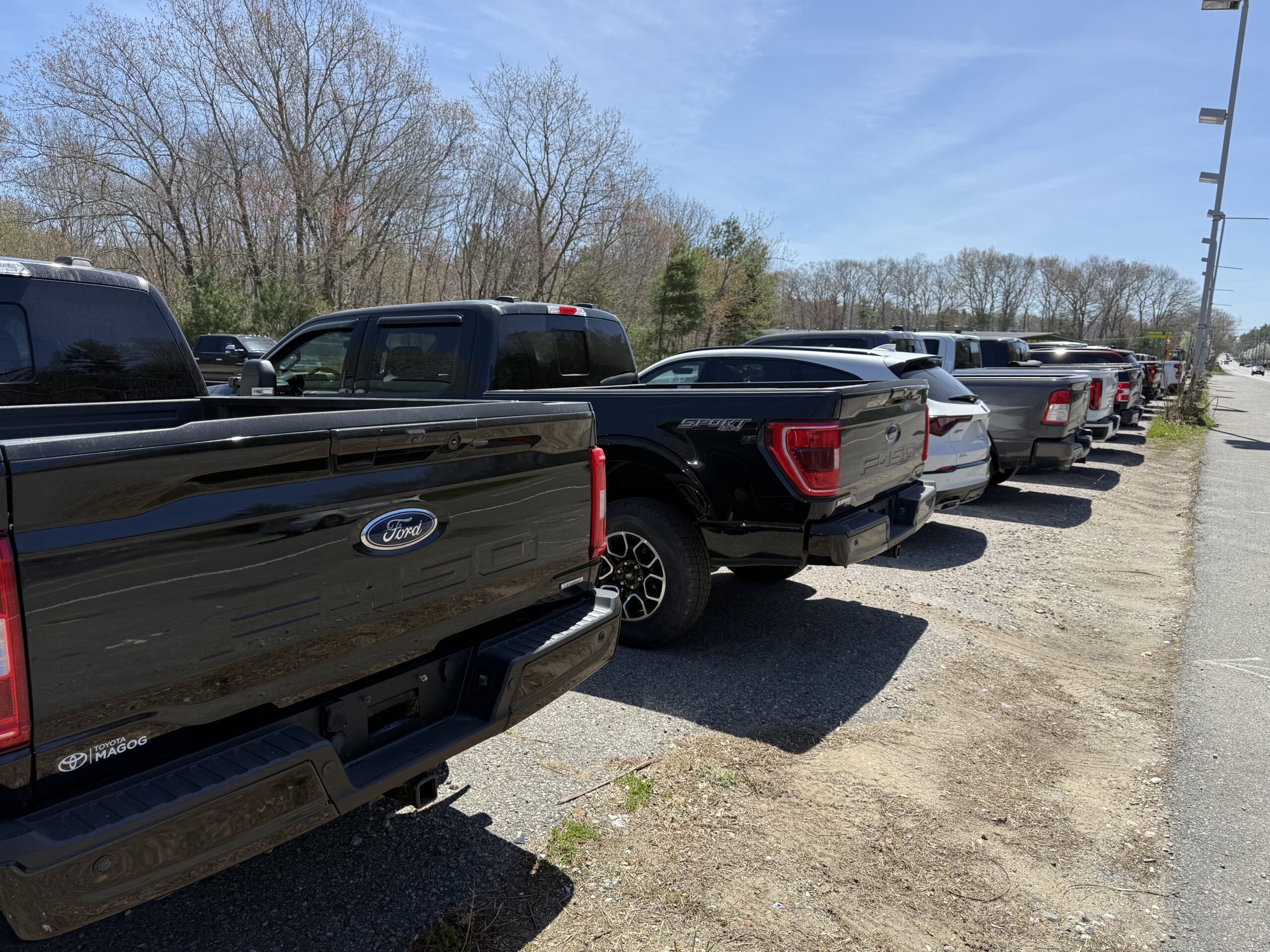
A friend’s father had a 2023 GMC Sierra 1500 Elevation: 5.3 V8, X31 package, bucket seats and console, with about 90,000 km. As I remember it, the truck sold for $38,000. My appraisal of a comparable U.S.-built truck at the time was roughly $44,000. That was an estimate of another configuration, not a second completed sale proving a $6,000 assembly premium.
We also bought a U.S.-built 2019 Ram 1500 Express, Hemi, around 130,000 km, in Orange Crush. It was lifted and had a topper. We paid $26,000; the seller reported a best competing offer of about $23,000. My Canadian-market comparison without that export opportunity was approximately $19,000–$20,000. Those are three different reference points: our purchase, an offer reported by the seller and my appraisal.
The Ram needed work. We replaced an axle and sourced and reinstalled the missing rear seats and belts before it went south. Its purchase price leaves out that preparation and the other costs of the transaction. Both stories explain why we look beyond a model badge. They do not establish a repeatable premium. All amounts in these two examples are Canadian dollars.
Start with the VIN, then the actual vehicle
Enter the complete VIN and model year in NHTSA’s VIN decoder, then read the plant information. The manufacturer supplies that information; ask it to resolve an incomplete or conflicting result. A brand’s nationality or the VIN’s first character is too little to base an export decision on.
Assembly country does not establish U.S. safety certification, emissions compliance or customs treatment. Keep clear photos of the vehicle labels and accurate ownership documents. Identify the engine, trim, factory packages and modifications rather than describing everything as “fully loaded.”
Condition and history still matter: kilometres, rust, mechanical faults, present damage and completed repairs all affect the assessment. Bring available repair invoices and explain unclear history entries. A report is one part of the file; entering a VIN in an estimate form does not mean a vehicle-history report has been retrieved and reviewed.
Check recalls with the manufacturer for the vehicle’s original market, and keep repair confirmations. NHTSA’s U.S. recall search has coverage gaps, including international vehicles. A clear result alone does not settle a Canadian vehicle’s status. Ask whether the applicable remedy and parts are available before scheduling transport.
A U.S. price is not the amount you receive
Suppose a genuine destination value were US$30,000. At an illustrative CAD$1.40 per US$1, that converts to CAD$42,000 before costs. It is a currency conversion, not a 40% profit or a comparison with the Canadian value of your truck. Use an achievable transaction rate when comparing a real proposal.
The buyer must allow for applicable duties and entry charges, transport, compliance work, repairs, selling costs and a commercial margin. Those costs depend on the vehicle and route; there is no single export allowance to subtract from every truck. A foreign retail asking price also leaves uncertainty about the actual selling price and time required.
Before relying on an export proposal, have the importer or customs broker confirm current duties and any additional tariff treatment for the vehicle and entry date. CBP’s U.S.-content guidance illustrates why documentation matters: assembly country alone is not a customs decision. Ask which costs are included, who pays them and how long the proposal remains valid.
A Canadian buyer may make the stronger offer once those costs are considered. In our experience, some Highlanders and hybrids have fitted the Montreal market better. Buyer demand changes with the specification, stock and timing. The same applies to pickups: an attractive export possibility still needs an available buyer.
If you plan to export the vehicle yourself
Find the destination buyer and confirm the permitted import route before booking transport. Exporting your own vehicle for sale is a different project from selling it to Murcot in Canada. Get the responsibilities, fees, payment terms and destination registration requirements in writing.
- Safety: NHTSA distinguishes conforming vehicles from those needing an eligible registered-importer route. A VIN decode is not safety certification.
- Emissions: EPA requires a separate check of the Canadian vehicle against a U.S.-certified configuration, supported by the applicable label or manufacturer compliance information.
- U.S. entry: CBP explains ownership evidence and entry documentation, including HS-7 and EPA 3520-1. Confirm the requirements for your proposed transaction with the port or broker.
- Canadian reporting: CBSA generally exempts non-restricted goods destined for U.S. consumption from an export declaration. Other documents or authorizations can still apply.
Personal-use guidance is not a resale authorization. In particular, NHTSA’s Canadian-certified Box 2B route is for personal use, not resale. Have the importer confirm a route that fits your transaction. Compare the resulting net proceeds, time and remaining uncertainty with a confirmed offer in Canada.
Selling to Murcot in Canada
Our family’s cross-border vehicle experience goes back to the 1970s. The practical lesson is to understand the vehicle and available buyer before treating a market opportunity as money. We consider Canadian and U.S. outlets when reviewing a purchase; your sale to Murcot is agreed in Canada, with the price and conditions explained.
- Send the VIN, kilometres, equipment and clear photos, including known damage.
- Tell us about financing or a lease, and provide an up-to-date payout when available.
- Review the vehicle details and any firm purchase offer with our team.
- If you accept, confirm payment, transfer documents and pickup arrangements within Quebec or Eastern Ontario.
An online range is preliminary and does not include a vehicle-specific condition or accident-history deduction. Our team reviews those details before confirming a firm offer. If money is owing, the lender or lessor’s requirements and any shortfall need review; a payout and recorded lien release may happen at different times.
Request a preliminary estimate for your vehicle, or read how an appraisal works. An export opportunity can inform the offer; the confirmed Canadian purchase terms are what you can use to make your decision.
Official guidance reviewed October 19, 2026. Confirm requirements for the vehicle, purpose and entry date before arranging an export.