
Can You Sell a Car Without Trading It In?
Yes — you can absolutely sell your car without trading it in, and in a lot of cases it's the smarter move. I buy cars directly from Quebec sellers every week at Murcot Auto, and one of the most common things I hear is some version of "I didn't even know this was an option." People assume their only choices are trading in at a dealership or rolling the dice on Kijiji. There's a lot more room in between than that.

In this post I'll walk you through how selling outright actually works, what it means for taxes here in Quebec, how loan payouts are handled, what goes wrong in private sales, and — honestly — the situations where I'd tell you not to sell at all.
Why People Want to Skip the Trade-In
Most people who come to us aren't avoiding dealerships because dealers are evil. They're avoiding them because of how the trade-in gets tangled into the rest of the deal.
When you trade in, the dealer is working four numbers at once: what you want for your trade, what you're paying for the new car, and what your monthly payment looks like. In the business it's sometimes called the four-square, and I call it what it is: smoke and mirrors. If they can tell you care most about your trade-in number, they'll give you all the money on the trade and take the profit somewhere else — the financing, the extended warranty, the price of the new car. If you want fourteen grand for your car, they'll find a way to make fourteen grand back across the rest of the deal. At the end of the day you don't actually know what you got for your car.
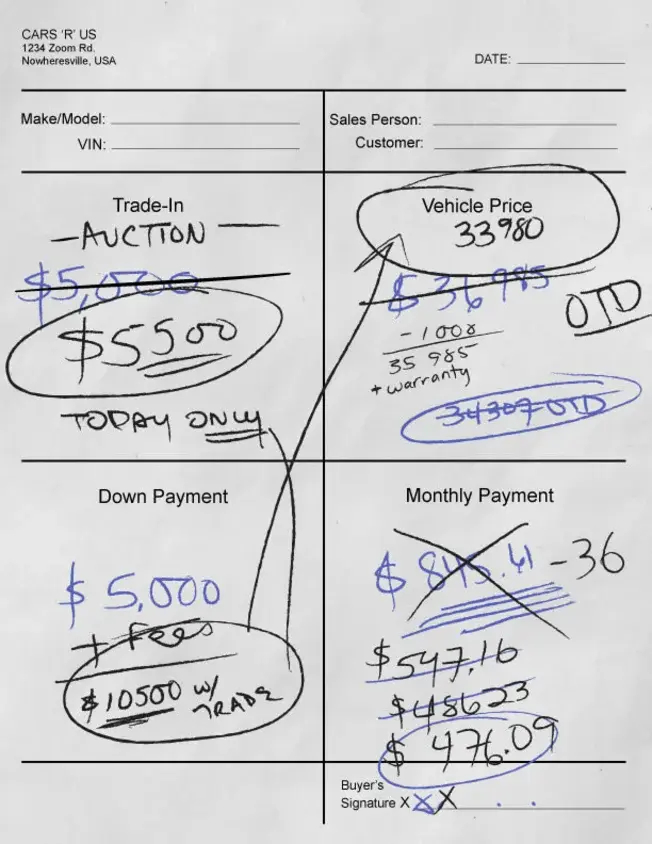
My advice, even if you end up trading in anyway: negotiate the price of the new car first, with the trade left completely out of the conversation. Once that price is locked, then bring up your car. Now you know exactly what each side of the deal is worth.
What About the Trade-In Tax Savings?
This is the big counterargument, and it's a fair one. In Quebec, when you trade in a vehicle against the purchase of another one, you only pay GST and QST on the difference. That's real money, and if you're buying another car right away, you shouldn't ignore it.

So here's the honest math: an outright sale has to beat the trade-in offer plus the tax savings you'd be giving up. If it doesn't, you're leaving money on the table. Sometimes it does beat it — and in some deals the transaction can even be structured so you sell the car and still get the tax credit applied on your next purchase. It depends on the situation, which is why it's worth asking the question instead of assuming trade-in is automatically the winner.
Either way, the starting point is the same: know your car's real value before selling, so you're comparing real numbers instead of guesses.
The flip side: if you're not buying another car right away, the tax credit is worth nothing to you. Selling outright also buys you breathing room. I see a lot of people panic-trade because everything has to happen in one afternoon, rush into a car they end up not liking, trade it again a year later, and slowly build this huge balloon of rolled-over debt. Selling first and shopping second breaks that cycle.
Your Options When You're Not Trading In
Selling Privately on Marketplace or Kijiji
I'll be straight with you: there are great private transactions happening every second on Marketplace and Kijiji. If you find a serious, trusted buyer, a private sale can be done in five minutes and be just as clean as dealing with us.
But I get the phone calls when it goes wrong, and it goes wrong in the same handful of ways:
Fraudulent bank drafts, fake wires, and bogus e-transfers that look real until they bounce
The proxy trap — a buyer takes the car with a signed proxy instead of doing the full SAAQ transfer, then holds or resells it without ever registering it. The car stays in your name, the tickets come to you, and I've had people get messed around with for months over this
The CARFAX scam — someone poses as a buyer, insists you buy a vehicle history report through their specific link to "prove" the car is clean, harvests your credit card info, and disappears
Plain old tire-kickers who burn your evenings and never show up
If you sell privately in Quebec, do the transfer properly and completely through the SAAQ (SAAQclic), both parties present, and don't hand over the car on a proxy. Make sure that transfer is done before the car leaves your sight. I cover the full private-sale process step by step in our simple guide to selling your car in Montreal.
Selling to a Direct Buyer
The other route is selling outright to a buyer like us. Our process is simple — I break it down in detail in how to sell your car in Montreal quickly and hassle-free, but the short version: you submit your vehicle online and get an automated instant price range so you know roughly what to expect. From there we evaluate the vehicle properly — accidents, past claims, tires, brakes, damage, general condition — and come back with a firm offer. If we make a deal, we need your driver's license, the registration, and any loan payout information, and the paperwork side is about a ten-minute situation.
There's a lot of competition out there buying cars, and realistically all any of us have is our word. So the way I run it is a solid, straightforward transaction with no surprises — because that's the only reputation that lasts.
Still Owe Money on the Car? Here's How That Works
This might be the most misunderstood part of selling without a trade-in, so let me spell it out with real numbers.

If You Have Equity
Say we agree on $30,000 for your car and you still owe $25,000 to the bank. We pay the lender the $25,000 directly and cut you a cheque for the $5,000 difference. Some customers prefer to pay out the loan themselves — that's fine, but you need full documentation of the payout, because the lien release doesn't happen instantly. Honestly, it's easier and faster when we handle it. We're accustomed to it, and we can't sell a vehicle until the lien is fully cleared anyway, so we like to control that step.
If You're Underwater
Very common right now: the car is worth $25,000 and you owe $30,000. To sell, you have to cover the $5,000 difference — cheque, cash, or e-transfer — because a vehicle cannot change hands with an existing lien on it. It has to be paid in full, right away.
The Personal-Loan Escape Route
For people who don't have the difference sitting in their account, there's an option most sellers have never heard of, and the banks are fine with it: convert the remaining car loan into a personal loan. It lengthens the process a bit, but it often lowers the payment and the interest rate — and more importantly, it lets you escape the depreciation trap. The car stops losing value on your dime, your losses are locked in and finite, and you can move on instead of watching the hole get deeper every month.
How to Prepare So the Sale Takes Ten Minutes

You don't need to do much, but the sellers who show up prepared get through the whole thing painlessly:
Driver's license and vehicle registration
Your exact loan payout amount, to the penny, from your bank — they'll usually give you a figure valid for a five-to-seven-day window
Both sets of keys if you have them
All the tires that go with the car (winter set included if it's part of the deal)
Your personal belongings out, your plate off
Paperwork ready to sign
That's it. Do that and it's a ten-minute situation.
When Selling Is the Wrong Move
I'll tell people not to sell, and here's when. If you're badly overleveraged — you owe twice what the vehicle is worth — selling or trading usually just buries you deeper. People lose so much money on a car that they're afraid to "lose again," so they flip it into another car, roll the debt, and keep digging. There's no way out of that loop except to stop. Sometimes the right answer is to sleep in the bed you made, keep the car you have, pay it down, and buy your next car from solid ground.
The other case: if the car has a real mechanical problem — a transmission on its way out, that kind of thing — you sometimes get more by fixing it before you sell than selling it as-is for next to nothing. It depends on the numbers, but it's worth doing the math before you take the as-is hit.
The Bottom Line

There are more options than Kijiji and trading it in at the dealer. You can always get your money if you're selling to the right person and following the proper steps. So don't stress, and don't rush — a lot of the pressure in this business exists because dealers need volume, not because your situation actually demands a decision today. Take your time, know your payout number, keep the trade-in out of the new-car negotiation, and sell your car on its own terms.
If you want to know what your car is worth without any obligation, enter your vehicle information here and you'll have a preliminary range in minutes.


Comments